- Over 25% of network engineers plan to retire within five years
- Documentation captures what people wrote down, not what they know
- Tribal knowledge loss compounds: slower resolution, more burnout, more turnover
Back
The Tribal Knowledge Problem: What Happens When Your Best Network Engineer Leaves
Prashanth VijayJUNE 26, 2026
Industry
Internet Service Providers (ISP)
Network Scale
The Tribal Knowledge Problem: What Happens When Your Best Network Engineer Leaves
Every network operations team has one. The engineer who knows why the BGP session to your upstream carrier flaps every Thursday at 2 AM. The one who remembers that a specific fiber route through lower Manhattan degrades during heavy rain because of a splice point that was never properly sealed. The one who can look at an alert and tell you in seconds whether it's a real outage or a carrier maintenance window that wasn't communicated properly.
That knowledge didn't come from a textbook or a training program. It was built over years of being on-call, investigating incidents, and learning the specific behaviors of a specific network. It's the kind of understanding that turns a 45-minute investigation into a 5-minute resolution, and it's almost never written down.
So what happens when that person leaves?
The Knowledge Walks Out the Door
In most network operations environments, the answer is simple: the knowledge disappears. It doesn't get transferred to a junior engineer during a two-week notice period. It doesn't live in a runbook, because nobody had time to write it down in the middle of a live incident, and by the time the incident was over, the team had moved on to the next one.
The result is that the remaining team suddenly finds itself operating a network they understand less than they did the week before. Incidents that used to take minutes to diagnose now take hours, because the person who could recognize the pattern at a glance is gone. Alerts that were previously triaged quickly now sit in the queue longer, because nobody is sure whether they're real or noise.
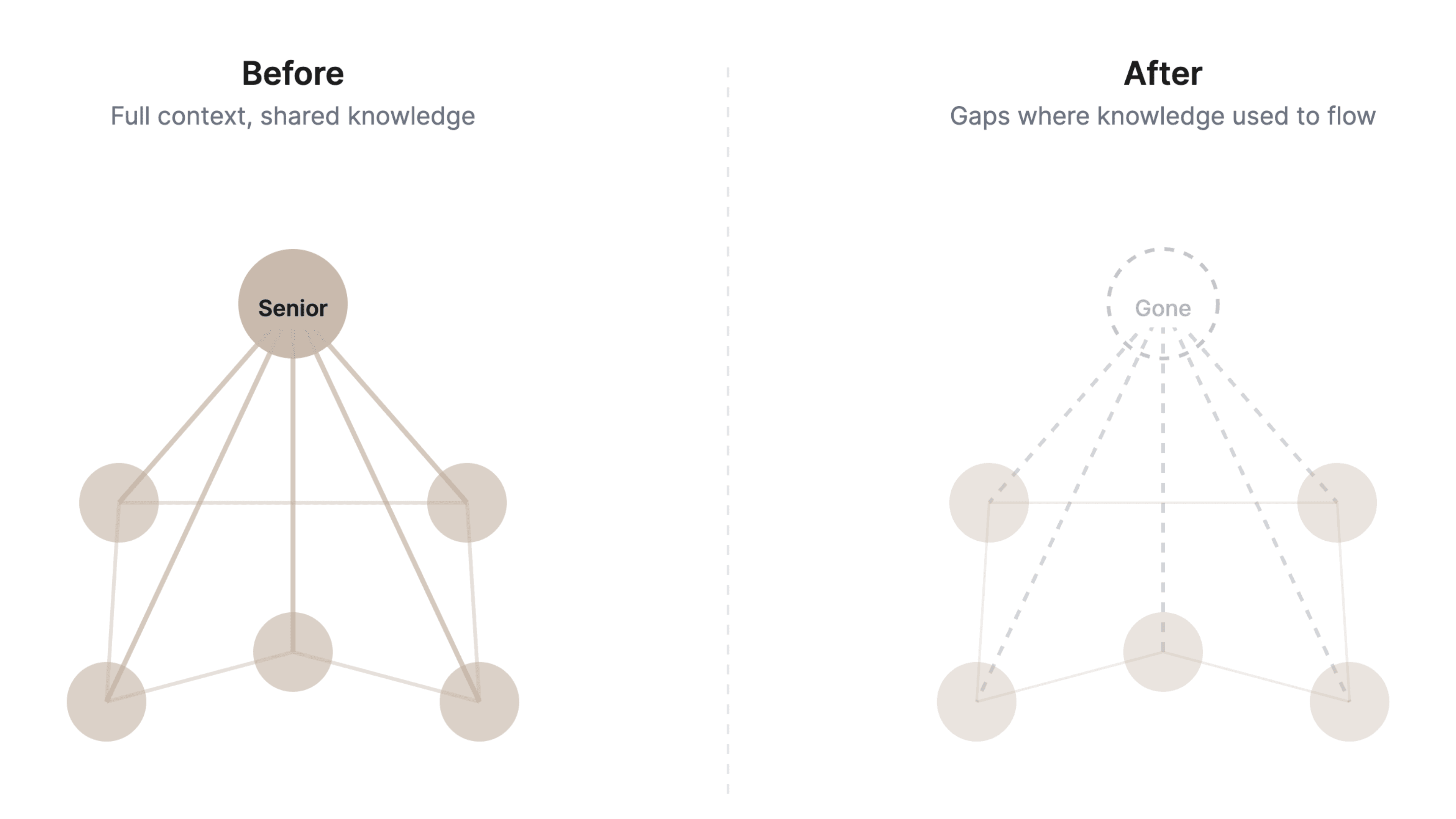 This isn't a hypothetical scenario. Over 25 percent of working network engineers will to retire within five years, and the telecom industry is facing a workforce gap that's growing faster than it can hire. Every time a senior engineer walks out the door, the institutional understanding of how that network actually behaves gets a little thinner.
Why Documentation Doesn't Solve This
The obvious response is to document everything. Write better runbooks, maintain a knowledge base, require post-mortems after every incident. These are good practices, and teams that do them consistently show measurably less variation in resolution times across team members.
But documentation has a fundamental limitation in network operations: it captures what people thought to write down, not what they actually know. The most valuable tribal knowledge is often the kind that's hardest to articulate, because it's pattern recognition built from experience rather than a discrete set of steps. When a 15-year veteran looks at an alert and says "that's the same thing that happened last March," they're drawing on a mental model of the network that no wiki page is going to replicate.
There's also a practical problem. Networks change constantly. Configurations evolve, traffic patterns shift, new devices get added, carrier relationships change. Documentation that was accurate six months ago might be misleading today, and the effort required to keep it current competes with the work of actually running the network. In most teams, the network wins that competition.
The Compounding Effect
The real cost of tribal knowledge loss isn't just slower incident resolution. It's the compounding effect on the team that remains.
When experienced engineers leave and institutional knowledge thins out, the remaining team takes longer to resolve incidents. Longer resolution times mean more time spent in reactive mode, which means less time available for the proactive work (documentation, automation, architecture improvements) that would make the team more resilient. Meanwhile, the added workload and stress contribute to further turnover, and the cycle continues.
Organizations with mature documentation practices show 40 to 50 percent less variation in MTTR across team members. But achieving that maturity requires investing in knowledge capture during exactly the periods when teams feel least able to spare the time, which is why most organizations never get there.
What Actually Needs to Change
The tribal knowledge problem isn't going to be solved by better wikis or more thorough post-mortems, although both help at the margins. The deeper issue is that critical operational context, the kind that experienced engineers carry in their heads, needs to live somewhere that's accessible, searchable, and connected to the real-time state of the network.
That means building systems that can capture and recall incident context automatically: what happened, what the network looked like when it happened, what the resolution was, and how similar the current situation is to past events. When a new alert fires, the system should be able to surface relevant history without anyone having to remember it or know where to look for it.
The goal isn't to replace the experience of a senior engineer. It's to make sure that experience doesn't vanish when they move on, and that the team behind them has access to the same context that made that engineer effective in the first place.
This is the problem we're solving at Supertrace. Our AI NOC agents continuously build long-term memory across every outage, post-mortem, and past remediation on your network. When a new alert fires, the system recalls similar incidents in real time, runs diagnostic traces across your infrastructure, and generates and tests hypotheses to identify root cause. It ingests the same messy signals your best engineer would: customer tickets, carrier notices, SNMP traps, syslogs, CLI output. And instead of relying on static runbooks that go stale, it builds just-in-time runbooks based on what it's learned from your network's actual history.
The result is that whoever is on call, whether they've been on the team for ten years or ten days, has access to the same depth of context that used to live only in your most experienced engineer's head. With human-in-the-loop control at every step, so your team stays in charge of the decisions that matter.
The tribal knowledge doesn't have to walk out the door. It just needs somewhere better to live.
Transform your network operations
Book a demo today